Some Chinese idioms make you smile the moment you hear them.
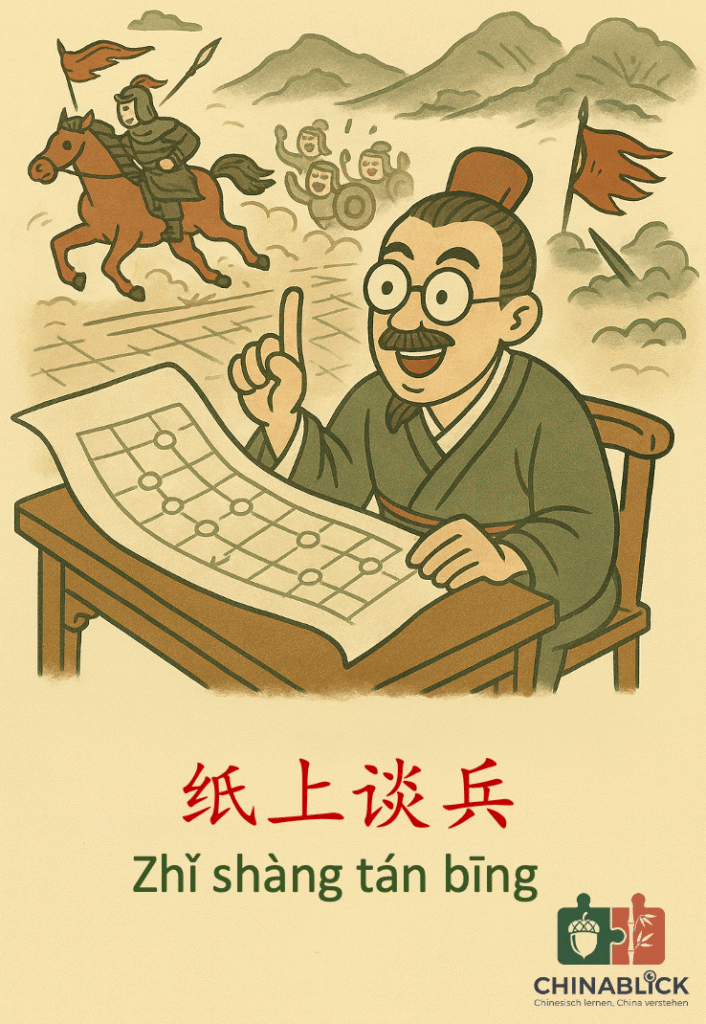
Take 纸上谈兵 (zhǐ shàng tán bīng), which literally means “discussing warfare on paper.” You can already picture it: someone hunched over books, talking strategy non-stop—yet totally clueless once it comes to real battle.
The Story of Zhao Kuo – a General on Paper
The idiom “纸上谈兵” comes from a famous story during the Warring States period.
There was a man named Zhao Kuo, son of a renowned general. He devoured military texts and could recite strategy at length. On paper, he was brilliant.
The problem? He had never led troops in real life.
When Zhao was appointed commander, he simply applied textbook theories word-for-word. His opponent quickly saw through him. In the decisive Battle of Changping, Zhao’s rigid tactics led to a disastrous defeat—hundreds of thousands of soldiers were trapped, and his army was destroyed.
From then on, “纸上谈兵” became a warning: don’t be the person who only talks theory but fails in practice.
Why “on paper”?
In Chinese culture, paper stands for knowledge, books, and theory.
Soldiers represent action, practice, and reality.
Put them together, and the message is clear: Theory without practice is not just useless—it can be dangerous.
Do we say this in English?
Yes, absolutely. Every culture has a way to poke fun at “armchair experts.”
In English, we might say:
- “All talk, no action.”
- Or mock someone as an “armchair general.”
The meaning overlaps perfectly: someone who sounds impressive in words, but collapses in action. It shows that whether in China or the West, people have little patience for empty talkers.
When do people say “纸上谈兵”?
This Chengyu is often used to criticize people who:
- Write endless plans at work but never execute them.
- Memorize theory in school but fail to apply it.
- Talk big in daily life but never follow through.
In short: lots of talk, zero results.
A Quick Dialogue 💬
A: He always talks like an expert in meetings.
B: Yeah, but when it comes to actually doing things, he fails. Classic 纸上谈兵!
Don’t let your Chengyu learning be “纸上谈兵”!
This idiom is a reminder that knowledge matters only when it’s put into practice.
So let’s not just read Chengyu—let’s use them! That’s how we make them come alive.
Chengyu Quiz 📝
Question: Which Chengyu describes someone who uses another’s power to intimidate others?
- A. 狐假虎威 (hú jiǎ hǔ wēi)
- B. 天壤之别 (tiān rǎng zhī bié)
- C. 掩耳盗铃 (yǎn ěr dào líng)
Find out the answer in our next post!
Last Time’s Quiz Answer 📝
Which Chengyu describes someone with a narrow view of the world, not seeing what lies beyond?
The correct answer is: 井底之蛙 (jǐng dǐ zhī wā) 🐸 – “a frog at the bottom of a well.”
It’s used for people whose perspective is limited and who think their tiny corner is the whole world.