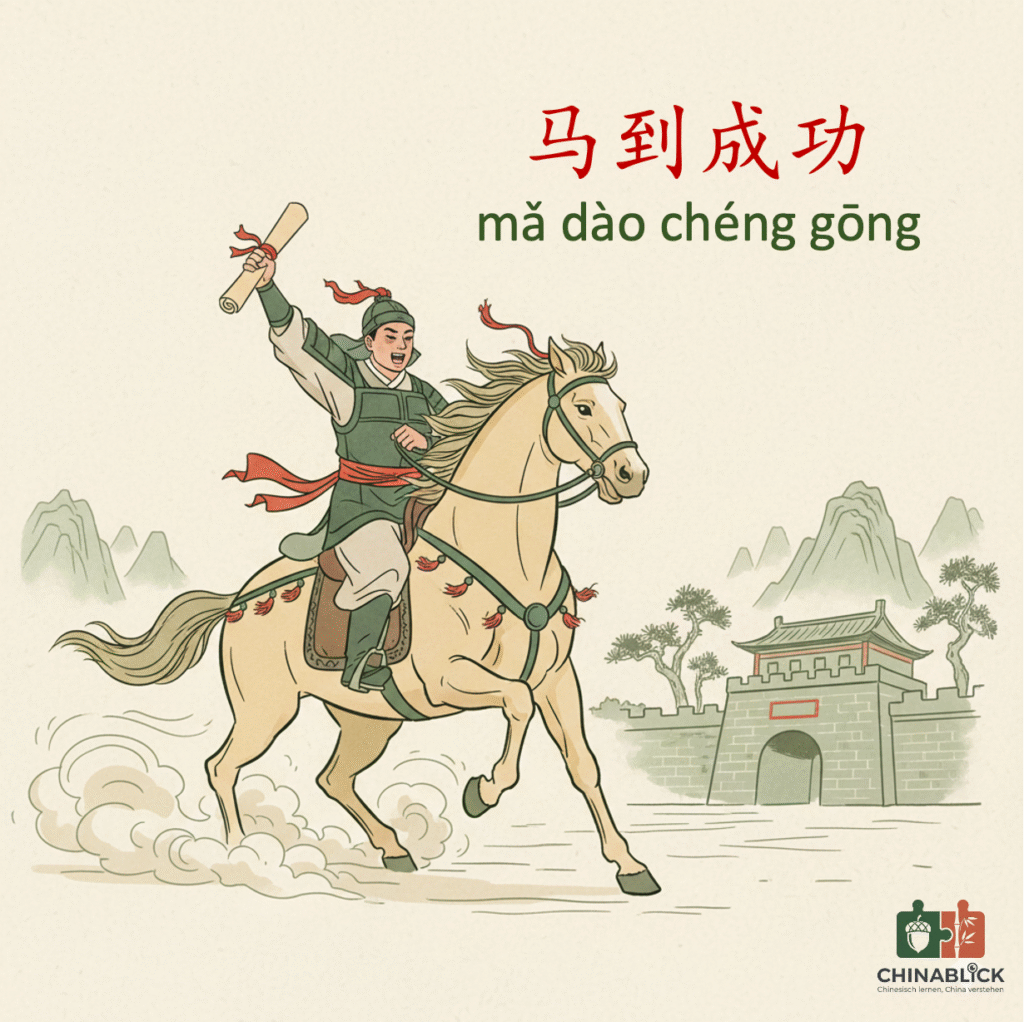
In Chinese, there’s a saying that people often use to wish someone instant success: 马到成功 (mǎ dào chéng gōng). Literally, it means “When the horse arrives, success follows.” Just four characters, yet they carry the feeling of power, speed, and certainty—almost as if victory is already within reach.
When the horse arrives, victory is here!
The origins of this expression go back to the Three Kingdoms period. Back then, horses were the most important part of any battle. A fast horse could bring troops to the battlefield in an instant and completely change the outcome.
According to legend, before one crucial fight, a famous general encouraged his soldiers by saying:
“Don’t be afraid! As soon as the warhorses arrive, victory will be ours!”
Sure enough, the horses charged ahead, morale soared, and the army won quickly. From then on, people began to use “马到成功” to wish others immediate success—swift and certain, just like a galloping horse.
Why a horse?
In ancient China, the horse was a symbol of speed, strength, and victory. Wars could not be fought without horses, and communication and transportation also relied heavily on them. That’s why the idea of “when the horse arrives, success follows” became such a powerful metaphor.
In other words, the horse was not just a means of transport, but in people’s minds the most reliable companion and a symbol of triumph.
How would you say it in English or German?
In English, we don’t have a perfect one-to-one match, but we often say things like:
- “Good luck!”
- “Wishing you success!”
- Or in a playful way, “Break a leg!”
In German, you might hear:
- „Viel Erfolg!“
- „Gutes Gelingen!“
- oder humorvoll: „Hals- und Beinbruch!“ (ähnlich wie im Englischen „Break a leg!“)
The interesting difference is this: Chinese emphasizes instant, certain victory—success arriving as fast as a horse. English and German, on the other hand, lean more toward good wishes and luck, less about certainty, more about hope.
A little learner’s story
马到成功 (mǎ dào chéng gōng)
三国的时候,有一个有名的将军。
Sānguó de shíhou, yǒu yī gè yǒumíng de jiāng jūn.
During the Three Kingdoms period, there was a famous general (jiāng jūn).
他带着很多士兵,准备去打仗。
Tā dàizhe hěn duō shìbīng, zhǔnbèi qù dǎ zhàng.
He led many soldiers (shìbīng) and prepared for a big battle (dǎ zhàng).
敌人很多,大家都很紧张。
Dírén hěn duō, dàjiā dōu hěn jǐnzhāng.
The enemy was strong, and everyone was nervous (jǐnzhāng).
可是,将军说:“不用怕。只要战马一到,胜利就会到!”
Kěshì, jiāngjūn shuō: “Búyòng pà. Zhǐyào zhàn mǎ yí dào, shènglì jiù huì dào!”
But the general said: “Don’t be afraid. Once the warhorses (zhàn mǎ) arrive, victory (shènglì) will also arrive!”
战马跑得很快,士兵们的士气也高了。
Zhàn mǎ pǎo de hěn kuài, shìbīng men de shìqì yě gāo le.
很快,他们就取得了胜利。
Hěn kuài, tāmen jiù qǔdé le shènglì.
The horses ran fast, the soldiers’ morale (shìqì) rose, and soon they won the battle (shènglì).
后来,人们用“马到成功”来祝福别人,希望他们一开始就能顺利成功。
Hòulái, rénmen yòng “mǎ dào chéng gōng” lái zhùfú biérén, xīwàng tāmen yì kāishǐ jiù néng shùnlì chénggōng.
Since then, people have used “马到成功” to wish others quick and certain success.
When do people say “马到成功”?
This Chengyu is most often used in moments of good wishes:
- Before an exam: 祝你马到成功! Zhù nǐ mǎ dào chéng gōng! (“Good luck on your test!”)
- Before a job interview: 祝你马到成功! (“May success come your way right away!”)
- At the start of a new year, a new semester, or a new job: You’ll often see “马到成功” written in greeting cards or festive messages, adding a cheerful, upbeat touch.
A quick dialogue
A: 明天我有考试。
Míngtiān wǒ yǒu kǎoshì.
A: Morgen habe ich eine Prüfung.
B: 祝你马到成功!
Zhù nǐ mǎ dào chéng gōng!
B: Ich wünsche dir Erfolg!
“马到成功” is more than just an old saying. It’s a way of sending energy, confidence, and encouragement in just four characters. And as the very first story in our Chengyu series, it brings us a good omen too: may our learning journey be as swift, strong, and successful as a galloping horse!
A Chengyu quiz
Question: Which Chengyu describes someone with a very narrow view of the world, who doesn’t see the bigger picture?
- A. 井底之蛙 (jǐng dǐ zhī wā) – “a frog at the bottom of a well”
- B. 狐假虎威 (hú jiǎ hǔ wēi) – “a fox taking power from a tiger”
- C. 盲人摸象 (máng rén mō xiàng) – “blind men touching an elephant”
Find out the answer in our next post!